Reaching the Unreached: Closing Public Health Gaps in Africa
-
by
AFENET
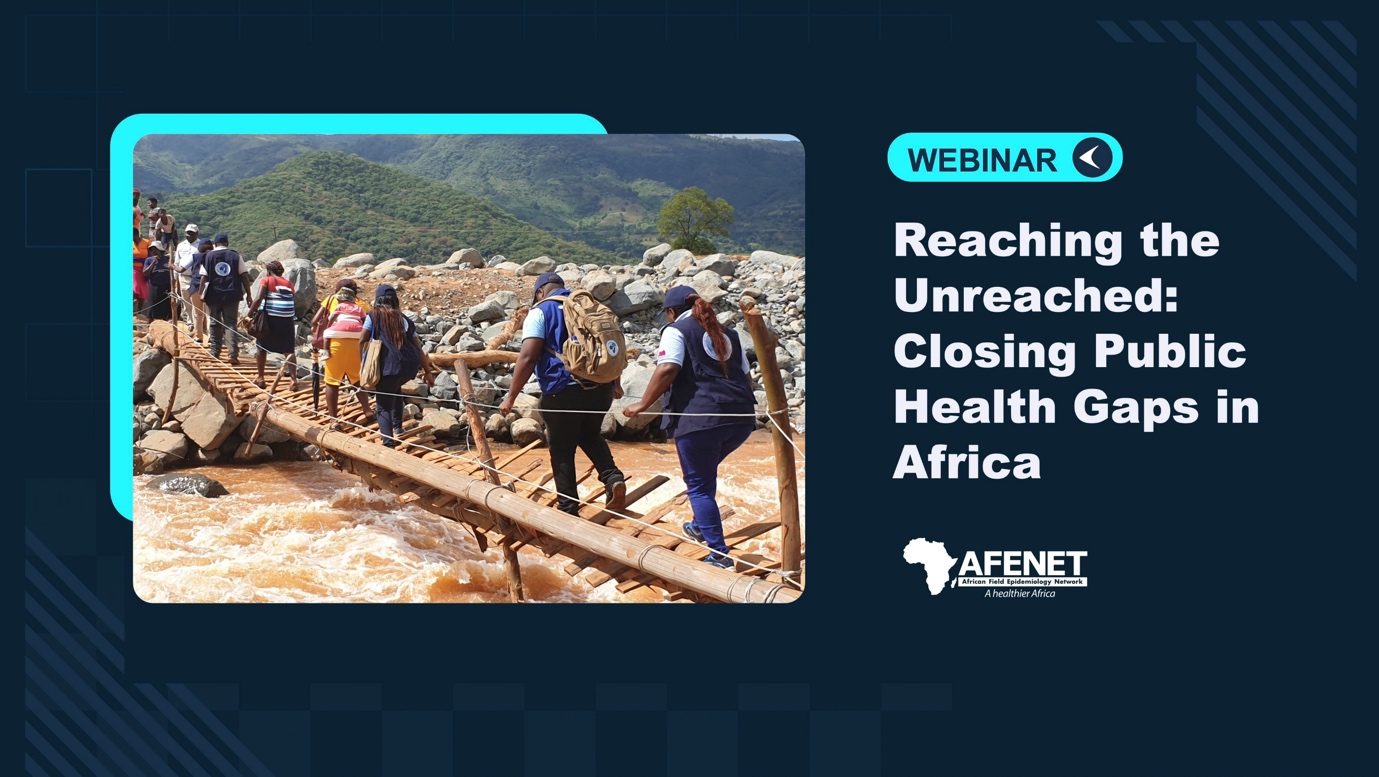
Africa has made significant progress in strengthening public health systems. Yet, as highlighted during a recent high-level webinar hosted by the African Field Epidemiology Network (AFENET), one defining challenge remains, the last mile is still the hardest to reach.
“The unreached are not invisible,” the discussion emphasized. “They are populations facing structural, geographic, and social barriers.”
These are communities living in urban informal settlements, remote rural areas, and fragile or conflict-affected settings, populations that continue to fall through the cracks despite broader gains in surveillance, immunization, and service delivery.
A Health System Is Only as Strong as Its Reach
Opening the session, AFENET Director Dr. Simon Antara grounded the discussion in a powerful and sobering reality:
“A health system is only as strong as its ability to reach its most vulnerable. If there are communities we cannot see, populations we do not count, or individuals we fail to serve, then our systems, no matter how advanced, remain incomplete.”
He went on to reflect on AFENET’s work across diverse and often challenging contexts:
“We operate in urban slums, in remote rural communities, and in fragile and conflict-affected settings. In each of these environments, we are constantly reminded that the unreached are not invisible, they are simply underserved. And unless we deliberately design systems to reach them, they will continue to be left behind.”
This perspective reframes the issue, not as a failure of visibility, but as a failure of reach.
The Reality Behind ‘Unreached’ Populations
The discussion made clear that being “unreached” is not about absence from the system, but about system limitations in responding to context.
Many of these populations are known. They exist within catchment areas, are reflected in census data, and are often targeted in national strategies. Yet, structural and contextual barriers continue to limit effective service delivery.
As highlighted during the webinar, these barriers include:
- Distance and difficult terrain
- Mobility linked to livelihoods such as farming or trade
- Weak or overstretched service delivery systems
- Social and trust-related dynamics within communities
In such contexts, standard approaches often fall short. What works in stable, urban settings may not translate to fragile or highly mobile populations.
From Coverage to Equity
A key shift emphasized during the discussion is the need to move beyond measuring success through aggregate coverage, toward a more nuanced understanding of equity and reach.
National indicators may show improvement, but they often mask persistent gaps at subnational and community levels.
As the discussion highlighted, progress must now be judged not only by how many are reached, but by who is consistently missed, and why.
Reaching the Unreached Requires a Different Approach
The panel underscored that closing these gaps requires more than strengthening systems—it requires rethinking how systems function at the last mile.
This includes:
- Designing interventions that reflect how communities live and move
- Strengthening microplanning to account for local realities
- Investing in frontline workers who understand community dynamics
- Building trust through consistent and responsive engagement
Reaching the unreached is therefore not a single intervention, it is an approach that must be embedded across all aspects of public health programming.
A Collective and Urgent Responsibility
Bringing together leadership from AFENET, CDC, and global partners, the webinar reinforced that reaching the unreached is a shared responsibility across institutions and sectors.
It requires alignment between national strategies and local implementation, and a commitment to ensuring that no population is overlooked.
As the conversation made clear, this is not a peripheral issue—it is central to the strength and credibility of health systems.
Looking Ahead: Redefining Success in Public Health
Africa stands at a critical moment. With continued investments in surveillance, workforce development, and service delivery, there is an opportunity to build systems that are not only stronger—but more inclusive.
But success must be defined differently.
Not only by the progress achieved,
but by the populations reached.
Not only by systems built,
but by systems that work for everyone.
Because in the end, public health is not only about expanding services—
it is about ensuring that every community, everywhere, is seen, understood, and served.
Voices from the Panel: A Shared Commitment to Reaching the Unreached
The webinar brought together key public health leaders, each offering perspectives shaped by their institutional roles and field experience—reinforcing that closing public health gaps requires coordinated, multi-level action.
Dr. Simon Antara
Director, African Field Epidemiology Network (AFENET)
“A health system is only as strong as its ability to reach its most vulnerable. If there are communities we cannot see, populations we do not count, or individuals we fail to serve, then our systems, no matter how advanced, remain incomplete.”
“At AFENET, we work across diverse contexts—urban slums, remote rural communities, and fragile and conflict-affected settings. In each of these environments, we are constantly reminded that the unreached are not invisible—they are simply underserved. Reaching them requires us to design systems that are responsive to how people actually live.”
Dr. Mary Adetinuke Boyd
Country Director, U.S. Centers for Disease Control and Prevention (CDC) – Uganda
“Reaching the unreached requires us to move beyond systems that work well on paper, to systems that work in practice, especially for communities facing the greatest barriers to access.”
“We must strengthen the connection between national strategies and what is happening at community level. That is where gaps become visible, and where solutions must be grounded.”
“Partnerships are critical. No single institution can close these gaps alone. It takes coordinated efforts across governments, implementing partners, and communities to ensure services reach those who need them most.”
Dr. Ngozi Erondu
Technical Director, Global Institute for Disease Elimination (GLIDE)
“Equity must be at the center of how we design and deliver public health interventions. If certain populations are consistently missed, then we must ask whether our approaches are truly inclusive.”
“The challenge of reaching the unreached is not just technical, it is systemic. It requires us to rethink how we deliver services, how we engage communities, and how we build trust.”
“We need to be intentional about identifying who is being left behind and why. Only then can we design interventions that are responsive, inclusive, and effective.”