AFENET strengthens capacity for surveillance, investigation and response to disease outbreaks in Somalia
-
by
AFENET
Somalia, an AFENET member country, is strategically positioned at the crossroads of trade and conflict, with the Gulf of Aden to the northwest, the Indian Ocean to the east, Ethiopia to the west, and Kenya to the southwest. For a long time, Somalia’s public health landscape has been fraught with challenges, from political instability to natural disasters. The WHO 2016 JEE findings in Somalia showed that there was lack of adequate workforce trained to detect, investigate, and respond to disease outbreaks at all levels of the health system. In addition, the country has the longest ongoing transmission of circulating vaccine-derived poliovirus type 2 (cVDPV2) outbreak globally, persisting for over seven years. This is mainly due to population movement and vulnerable communities, such as nomadic populations and internally displaced persons (IDPs). Therefore, the importance of tracking down and responding to outbreaks before they spread is paramount.
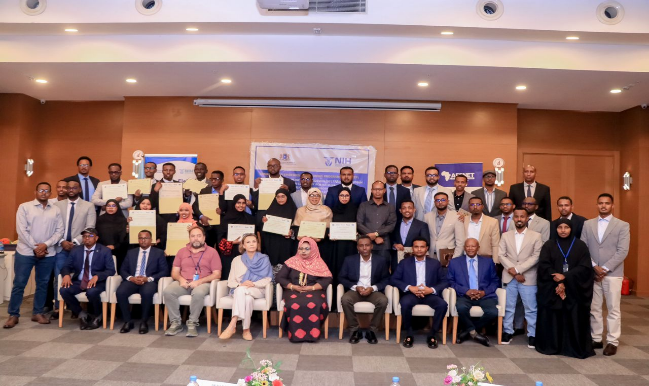
AFENET, in collaboration with United States Centers for Disease Control and Prevention (CDC) and WHO supported the Federal Ministry of Health (MOH), and National Institute of Health (NIH) to commence the first cohort of Somalia Frontline Field Epidemiology Training Program (FETP), in August 2021. In addition, in September 2023 MOH and AFENET leveraged the experiences and strong support from development partners to launch frontline-FETP with focused immunization sessions including polio, routine immunization, and vaccine-preventable disease (VPD) to build the capacity of public health workers in high-risk polio geographies.
The FETP graduates have since played a pivotal role in implementing and enhancing integrated disease surveillance and response (IDSR), significantly improving the timeliness, flexibility, and coverage of disease alert responses. To-date, 123 health workers have successfully completed the courses and are working with health authorities at all levels of the health system. Specifically, they have investigated 54 measles outbreaks, 17 cholera outbreaks, nine suspected dengue fever outbreaks and a smaller number of influenza-like illnesses, COVID-19, suspected Mpox, acute flaccid paralysis, pertussis, and neonatal tetanus. Notably, 51% of these outbreaks were responded to within 48-72 hours of reporting, demonstrating the Program’s enhanced efficiency and effectiveness.
Building the capacity of frontline health workers in key geographies will support the Somalia MOH and other stakeholders to reach and protect vulnerable populations and communities at risk of poliovirus or other VPDs. Furthermore, incorporating routine immunization sessions into frontline FETP is a unique opportunity for increasing the trainee’s understanding of the skills needed to assess gaps, plan and implement other activities like micro planning, cold chain, social mobilization and data management.
With the country’s 15.4 million population growing at nearly 3% and expected to double in 24 years, the importance of building a competent national workforce trained to detect, investigate, and respond to disease outbreaks at all levels of the health system cannot be overemphasized and AFENET is committed to work with partners in this region to pursue this objective.